

x86 programming for Ms Dos Computers in CGA , EGA and VGA

| In these tutorials, we'll take a look at the early basic
machines, and learn how we can use Assembly to write games that can
be used in MSDos via DosBox! We'll cover 3 graphics modes...
|
 |
 |
If you want to learn 8086 get the Cheatsheet! it has all the 8086 commands, It will help you get started with ASM programming, and let you quickly look up commands when you get confused! |  |
Useful Documents
MASM61PROGUIDE
- Microsoft Assembler guide
MASM - Microsoft's
Dos based assembler
80x86 IBM PC and Compatible Computers - Programming guide
8086/186 - Intel CPU manual

ChibiAkumas Tutorials
8086 Hello World Series
| Lesson H1 - Hello World on MS Dos |
| Lesson H3 - Hello World on MS Dos via Native Tools (MASM 6.11) [DOS] |
8086 Simple Samples
| Lesson S1 - Sprite drawing and Simple key movement in MS DOS |
8086 Platform Specific Lessons
8086 SuckHunt Series
| Lesson SuckShoot1 - Suck Shoot on the 8086 [DOS] |
| Lesson SuckShoot4 - Suck Shoot on the 8086 with CGA [DOS] |
CGA color Palette
| Palette 0 Dark | Palette 0 Bright |
Palette 1 Dark | Palette 1 Bright | |
| 0 | ||||
| 1 | ||||
| 2 | ||||
| 3 |
EGA color Palette
The EGA system uses 16 colors - it's 320x200 can only use a palette of 16 colors (the same colors!)
Each color has a logical number from 0-16, and a Hardware number (used for palette definitions) from 0-63
| 0 - 0 | 1 - 1 | 2 - 2 | 3 - 3 | 4 - 4 | 5 - 5 | 6 - 20 | 7 - 7 |
| 8 - 56 | 9 - 57 | 10 - 58 | 11 - 59 | 12 - 60 | 13 - 61 | 14 - 62 | 15 - 63 |
EGA Ports
| Port | AH | AL | Purpose |
| 03C0h
|
%--RGBrgb | 00h | Palette |
| 03C0h | %--RGBrgb | 01h | Palette |
| 03C0h | %--RGBrgb | 02h | Palette |
| 03C0h | %--RGBrgb | 03h | Palette |
| 03C0h | %--RGBrgb | 04h | Palette |
| 03C0h | %--RGBrgb | 05h | Palette |
| 03C0h | %--RGBrgb | 06h | Palette |
| 03C0h | %--RGBrgb | 07h | Palette |
| 03C0h | %--RGBrgb | 08h | Palette |
| 03C0h | %--RGBrgb | 09h | Palette |
| 03C0h | %--RGBrgb | 0Ah | Palette |
| 03C0h | %--RGBrgb | 0Bh | Palette |
| 03C0h | %--RGBrgb | 0Ch | Palette |
| 03C0h | %--RGBrgb | 0Dh | Palette |
| 03C0h | %--RGBrgb | 0Eh | Palette |
| 03C0h | %--RGBrgb | 0Fh | Palette |
| 03C0h | %----MMMM | 10h | Mode Control |
| 03C0h | %--OOOOOO | 11h | Overscan |
| 03C0h | %--DDPPPP | 12h | Color plane enable |
| 03C0h | %----PPPP | 13h | Horizontal panning |
| 03C2h | %IFFS---- | 00h | Input status 0 register |
| 03C2h | %VHBDCEc | 01h | Misc Output register |
| 03C4h | %------SA | 00h | Sequencer reset |
| 03C4h | %----CScD | 01h | Sequence clocking mode |
| 03C4h | %----3210 | 02h | Write mask register plane n) |
| 03C4h | %----CCcc | 03h | Character map select |
| 03C4h | %-----OMA | 04h | Memory mode |
| 03CAh | %------PP | Graphics 2 position | |
| 03CCh | %------PP | Graphics 1 position | |
| 03CEh | %----3210 | 00h | In Write mode 0 set bit according to 3CEh |
| 03CEh | %----3210 | 01h | In Write mode 0 set bit according to 3CEh |
| 03CEh | %----3210 | 02h | In Write mode 0 set bit according to 3CEh |
| 03CEh | %----3210 | 03h | In Write mode 0 set bit according to 3CEh |
| 03CEh | %------PP | 04h | Read Bitplane register |
| 03CEh | %--CORFWW | 05h | Read/Write Mode |
| 03CEh | %----MMOG | 06h | Graphics Misc |
| 03CEh | %----3210 | 07h | Ignore bitplane register |
| 03CEh | %BBBBBBBB | 08h | Bit mask register |
| 03D4h | %HHHHHHHH | 00h | CRTC Horizontal Total |
| 03D4h | %HHHHHHHH | 01h | CRTC Horizontal Display End |
| 03D4h | %HHHHHHHH | 02h | CRTC Start Horiz Blanking Register |
| 03D4h | %-CCHHHHH | 03h | CRTC End Horiz Blanking Register |
| 03D4h | %HHHHHHHH | 04h | CRTC Start Horiz Retrace Register |
| 03D4h | %DCCHHHHH | 05h | CRTC End Horiz Retrace Register |
| 03D4h | %VVVVVVVV | 06h | CRTC Vertical Blank Total |
| 03D4h | %---LSEDT | 07h | CRTC Overflow register |
| 03D4h | %---LLLLL | 08h | CRTC Preset Row Scan Register |
| 03D4h | %---LLLLL | 09h | CRTC Maximum scan line register |
| 03D4h | %---CCCCC | 0Ah | CRTC Cursor Start Reg |
| 03D4h | %-DDCCCCC | 0Bh | CRTC Cursor End Reg |
| 03D4h | %AAAAAAAA | 0Ch | CRTC Cursor Start Address High Reg |
| 03D4h | %AAAAAAAA | 0Dh | CRTC Cursor Start Address Low Reg |
| 03D4h | %CCCCCCCC | 0Eh | CRTC Cursor Location High Reg |
| 03D4h | %CCCCCCCC | 0Fh | CRTC Cursor Location Low Reg |
| 03D4h | %VVVVVVVV | 10h | CRTC Vertical Retrace Start Reg |
| 03D4h | %PPPPPPPP | 11h | CRTC Light Pen Low Register (Read) |
| 03D4h | %--ICVVVV | 11h | CRTC Vertical Retrace End Reg (Write) |
| 03D4h | %VVVVVVVV | 12h | CRTC Virtical Display End Register |
| 03D4h | %OOOOOOOO | 13h | CRTC Offset Register |
| 03D4h | %---UUUUU | 14h | CRTC Underline location Reg |
| 03D4h | %VVVVVVVV | 15h | CRTC Start Vert Blanking Register |
| 03D4h | %---VVVVV | 16h | CRTC End Vert Blanking Register |
| 03D4h | %RWBDCSHc | 17h | CRTC: Mode control register |
| 03D4h | %LLLLLLLL | 18h | CRTC: Line Compare Register |
| 03DAh | %--CCVLlR | Input Status 1 Register (Read) | |
| 03DAh | %------OO | Feature Control Register (Write) |
Screen Layouts
CGA is a 2bpp screen mode, it's memory is at B800:0000h
EGA use 4 bitplanes, it's address is A000:0000... to change the bitplanes we need to OUT to 03C4h
VGA is a 8bpp screen mode, it's memory is at A000:0000h
| Bits | ||||||||||||
| Screen Mode | Bits per pixel | Pixels per byte | Address | Plane Mask | 7 | 6 | 5 | 4 | 3 | 2 | 1 | 0 |
| CGA - 4 | 2 bpp | 4 | B800:0000h | b1 | b0 | b1 | b0 | b1 | b0 | b1 | b0 | |
| EGA - 13 | 4 bitplanes | 8 | A000:0000h | out 03c4h,0102h | p0-b7 | p0-b6 | p0-b5 | p0-b4 | p0-b3 | p0-b2 | p0-b1 | p0-b0 |
| out 03c4h,0202h | p1-b7 | p1-b6 | p1-b5 | p1-b4 | p1-b3 | p1-b2 | p1-b1 | p1-b0 | ||||
| out 03c4h,0302h | p2-b7 | p2-b6 | p2-b5 | p2-b4 | p2-b3 | p2-b2 | p2-b1 | p2-b0 | ||||
| out 03c4h,0402h | p3-b7 | p3-b6 | p3-b5 | p3-b4 | p3-b3 | p3-b2 | p3-b1 | p3-b0 | ||||
| out 03c4h,0F02h | All-b7 | All-b6 | All-b5 | All-b4 | All-b3 | All-b2 | All-b1 | All-b0 | ||||
| VGA | 8bpp | 1 | A000:0000h | b7 | b6 | b5 | b4 | b3 | b2 | b1 | b0 | |
Beeper Sound Ports
| Port | Modes | Purpose | Bits | Notes |
| 0040 | RW | PIT counter 0, counter divisor (XT, AT, PS/2) | CCCCCCCC | Send L/H Pair |
| 0041 | RW | PIT counter 1, RAM refresh counter (XT, AT) | CCCCCCCC | Send L/H Pair |
| 0042 | RW | PIT counter 2, cassette & speaker (XT, AT, PS/2) | CCCCCCCC | Send L/H Pair |
| 0043 | RW | PIT mode port, control word register for counters 0-2 | CCAAMMMS | C=Counter select (0-2), A=counter Access, M=counter Mode (0-5), S=counter Style (0=16 bit 1=BCD) |
| 0061 | W | PPI Programmable Peripheral Interface 8255 (XT only) | ----PPST | P= parity checks S=Speaker enable T=speaker Timer enable |
| 0061 | R | KB controller port B control register (ISA, EISA) | EETDPPST | E=errors T=Timer D=Detect P= parity checks S=Speaker enable T=speaker Timer enable |
Adlib OPL2 Registers
The ADLIB sound card usesd OPL2, which is also supported by the full SoundBlaster range, it uses a range of registers to make its sounds, each sound channel is formed by a combination of two Operators
NOTE: OPL3 doubled the number of registers, with an 'Advanced' set... for simplicity (and my sanity) we'll just be covering the basic OPL2 set, which are supported by OPL3 as well!
There are a total of up to 9 sound channels... each sound is the
combination of two "OP signals"... we should set both to get a sound
from a channel! How the OPs are combined is defined by bit 0 of
registers C0h-C8h... see the pdf documents for more info.
| Channel Signal | 1 | 2 | 3 | 4 | 5 | 6 | 7 (Ryt) |
8 (Ryt) |
9 (Ryt) |
|||||||||
| OP1 Slot 1 Signal | 1 | 2 | 3 | 7 | 8 | 9 | 13 | 14 | 15 | |||||||||
| OP2 Slot 2 Signal | 4 | 5 | 6 | 10 | 11 | 12 | 16 | 17 | 18 | |||||||||
| Register settings for slot |
20 | 21 | 22 | 28 | 29 | 2A | 30 | 31 | 32 | |||||||||
| 23 | 24 | 25 | 2B | 2C | 2D | 33 | 34 | 35 | ||||||||||
| 40 | 41 | 42 | 48 | 49 | 4A | 50 | 51 | 52 | ||||||||||
| 43 | 44 | 45 | 4B | 4C | 4D | 53 | 54 | 55 | ||||||||||
| 60 | 61 | 62 | 68 | 69 | 6A | 70 | 71 | 72 | ||||||||||
| 63 | 64 | 65 | 6B | 6C | 6D | 73 | 74 | 75 | ||||||||||
| 80 | 81 | 82 | 88 | 89 | 8A | 90 | 91 | 92 | ||||||||||
| 83 | 84 | 85 | 8B | 8C | 8D | 93 | 94 | 95 | ||||||||||
| E0 | E1 | E2 | E8 | E9 | EA | F0 | F1 | F2 | ||||||||||
| E3 | E4 | E5 | EB | EC | ED | F3 | F4 | F5 | ||||||||||
| Register settings for the channel |
A0 | A1 | A2 | A3 | A4 | A5 | A6 | A7 | A8 | |||||||||
| B0 | B1 | B2 | B3 | B4 | B5 | B6 | B7 | B8 | ||||||||||
| C0 | C1 | C2 | C3 | C4 | C5 | C6 | C7 | C8 | ||||||||||
Channels 7,8,9 can be toggled as Rhythm effects by setting bit 5 of 0BDh to 1
In this mode bits 0-4 of 0BDh will 'fire' the effects... each
effect uses some of the signal slots, the registers for this slot will
need to be set up as usual
BDh bits %DDRBSTCH
R=Rhythm enabled (channel 7-9 no longer normal FM sound)
| Bit / Rhythm sound |
OP / Signal Slots used |
| B=Bass | 13 & 16 |
| S=Snare | 17 |
| T=Tom | 15 |
| C=Cymbal | 18 |
| H=Hihat | 14 |
Sound over time
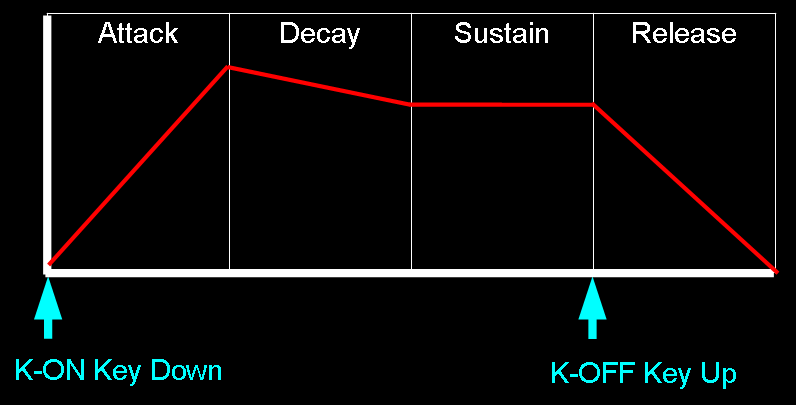
The OPs define how the sound level changes over time... K-On and K-Off mimic the way piano keys work.. when the key is struck the sound will start (Attack), and fade slowly (Decay) to a constant tone (Sustain), when the key is lifted, it will fade quickly (Release)
Adlib OPL2 Registers and bits
| Register | Details | Bits | Details |
| 01h | Test | --WDDDDD | W=Wave select Enable (opl2) / D=Test Data |
| 02h | Timer 1 Setting 80-20.4us | TTTTTTTT | T=Timer |
| 03h | Timer 2 Setting 320-82 us | TTTTTTTT | T=Timer |
| 04h | Timer 1/2 control | RMM---SS | R=Reset M=Mask S=? |
| 08h | Speech Synth / Keyboard Split NoteSel | CS------ | C=CSM Speech synth mode / S=note Select |
| 20h - 35h | Multi / Key Scale Rate / EG-Type Tone / Vibrato / AM modulation | AVEKMMMM | A=AM V=VIB E=EG-Typ K=KSR M=Multiple |
| 40h - 55h | Total Level / Key Scale Level | KKTTTTTT | K=KeyScaleLevel T=Total Level (0=loud) |
| 60h - 75h | Decay Rate / Attack Rate | AAAADDDD | A=Attack (0=slow) D=Decay (0=slow) |
| 88h - 95h | Release Rate / Sustain Level | SSSSRRRR | S=Sustain (0=loud) R=Release (0=slow) |
| A0h - A8h | F number | FFFFFFFF | F=Fnumber L |
| B0h - B8h | Block / K-ON | --KBBBFF | F=Fnumber H B=Block K=K-on |
| BDh | Rhythm mode (Chn 7-9) / Vibrato Depth / AM Depth | DDRBSTCH | D=Depth
(AM/VIB) R=Rhythm B=Bass(13,16) S=Snare(17) T=Tom(15) C=Cymbal(18) H=Hihat(14) |
| C0h - C8h | FeedBack factor / C=Connection sine/fm | ----FFFC | F=Feedback
C=Connection (Op combination mode) |
| E0h - F5h | Wave Select | ------WW | WW=Wave Select |
| (Address port Read) | Status Reg | IFF----- | I=IRQ F=Flag |
Useful ADLIB docs:
yamaha_ymf262
- OPL3 Manual (Adlib Gold / SB16)
YM3812 - OPL2
Manual (adlib)
ym3625 -
OPL(1) manual
Soundblaster -
Soundblaster programming guide
Adlib
Programming - Adlib programming guide
| View Options |
| Default Dark |
| Simple (Hide this menu) |
| Print Mode (white background) |
| Top Menu |
| ***Main Menu*** |
| Youtube channel |
| Patreon |
| Introduction to Assembly (Basics for absolute beginners) |
| Amazon Affiliate Link |
| AkuSprite Editor |
| ChibiTracker |
| Dec/Bin/Hex/Oct/Ascii Table |
| Alt Tech |
| Archive.org |
| Bitchute |
| Odysee |
| Rumble |
| DailyMotion |
| Please note: I wlll upload more content to these alt platforms based on the views they bring in |
| 68000 Content |
| ***68000 Tutorial List*** |
Learn 68000 Assembly  |
| Hello World Series |
| Platform Specific Series |
| Simple Samples |
| Grime 68000 |
| 68000 Downloads |
| 68000 Cheatsheet |
| Sources.7z |
| DevTools kit |
| 68000 Platforms |
| Amiga 500 |
| Atari ST |
| Neo Geo |
| Sega Genesis / Mega Drive |
| Sinclair QL |
| X68000 (Sharp x68k) |
| 8086 Content |
| Learn 8086 Assembly |
| Platform Specific Series |
| Hello World Series |
| Simple Samples |
| 8086 Downloads |
| 8086 Cheatsheet |
| Sources.7z |
| DevTools kit |
| 8086 Platforms |
| Wonderswan |
| MsDos |
| ARM Content |
| Learn ARM Assembly |
| Learn ARM Thumb Assembly |
| Platform Specific Series |
| Hello World |
| Simple Samples |
| ARM Downloads |
| ARM Cheatsheet |
| Sources.7z |
| DevTools kit |
| ARM Platforms |
| Gameboy Advance |
| Nintendo DS |
| Risc Os |
| Risc-V Content |
| Learn Risc-V Assembly |
| Risc-V Downloads |
| Risc-V Cheatsheet |
| Sources.7z |
| DevTools kit |
| MIPS Content |
| Learn Risc-V Assembly |
| Platform Specific Series |
| Hello World |
| Simple Samples |
| MIPS Downloads |
| MIPS Cheatsheet |
| Sources.7z |
| DevTools kit |
| MIPS Platforms |
| Playstation |
| N64 |
| PDP-11 Content |
| Learn PDP-11 Assembly |
| Platform Specific Series |
| Simple Samples |
| PDP-11 Downloads |
| PDP-11 Cheatsheet |
| Sources.7z |
| DevTools kit |
| PDP-11 Platforms |
| PDP-11 |
| UKNC |
| TMS9900 Content |
| Learn TMS9900 Assembly |
| Platform Specific Series |
| Hello World |
| TMS9900 Downloads |
| TMS9900 Cheatsheet |
| Sources.7z |
| DevTools kit |
| TMS9900 Platforms |
| Ti 99 |
| 6809 Content |
| Learn 6809 Assembly |
| Learn 6309 Assembly |
| Platform Specific Series |
| Hello World Series |
| Simple Samples |
| 6809 Downloads |
| 6809/6309 Cheatsheet |
| Sources.7z |
| DevTools kit |
| 6809 Platforms |
| Dragon 32/Tandy Coco |
| Fujitsu FM7 |
| TRS-80 Coco 3 |
| Vectrex |
| 65816 Content |
| Learn 65816 Assembly |
| Hello World |
| Simple Samples |
| 65816 Downloads |
| 65816 Cheatsheet |
| Sources.7z |
| DevTools kit |
| 65816 Platforms |
| SNES |
| eZ80 Content |
| Learn eZ80 Assembly |
| Platform Specific Series |
| eZ80 Downloads |
| eZ80 Cheatsheet |
| Sources.7z |
| DevTools kit |
| eZ80 Platforms |
| Ti84 PCE |
| IBM370 Content |
| Learn IBM370 Assembly |
| Simple Samples |
| IBM370 Downloads |
| IBM370 Cheatsheet |
| Sources.7z |
| DevTools kit |
| Super-H Content |
| Learn SH2 Assembly |
| Hello World Series |
| Simple Samples |
| SH2 Downloads |
| SH2 Cheatsheet |
| Sources.7z |
| DevTools kit |
| SH2 Platforms |
| 32x |
| Saturn |
| PowerPC Content |
| Learn PowerPC Assembly |
| Hello World Series |
| Simple Samples |
| PowerPC Downloads |
| PowerPC Cheatsheet |
| Sources.7z |
| DevTools kit |
| PowerPC Platforms |
| Gamecube |
| Work in Progress |
| ChibiAndroids |
| Misc bits |
| Ruby programming |
Buy my Assembly programming book
on Amazon in Print or Kindle!

Available worldwide!
Search 'ChibiAkumas' on
your local Amazon website!
Click here for more info!

Buy my Assembly programming book
on Amazon in Print or Kindle!
Available worldwide!
Search 'ChibiAkumas' on
your local Amazon website!
Click here for more info!
Buy my Assembly programming book
on Amazon in Print or Kindle!
Available worldwide!
Search 'ChibiAkumas' on
your local Amazon website!
Click here for more info!